
An architect spends weeks perfecting a design, balancing creativity, functionality, and client expectations. But once the project approaches the construction stage, even a small design clash between architectural, structural, or MEP components can lead to costly delays and rework. One of the biggest challenges faced by architects today is maintaining design accuracy throughout the lifecycle.
That is where Building Information Modeling (BIM) is transforming the AEC industry. BIM is no longer a visualization tool; it has become a data-driven process that allows architects, engineers, contractors, and consultants to work within a coordinated digital environment, unlike traditional 2D drafting workflows. It helps architects improve design accuracy, reduce coordination errors, and streamline collaboration.
Food for Thought!
Studies show that BIM implementation can shorten project timelines by nearly 20%, reduce overall costs by 15%, lower design errors by 30%, and decrease RFIs by 25%.
Understanding Design Accuracy in Architecture
Design accuracy refers to the precision and reliability of architectural information throughout the design and construction process.
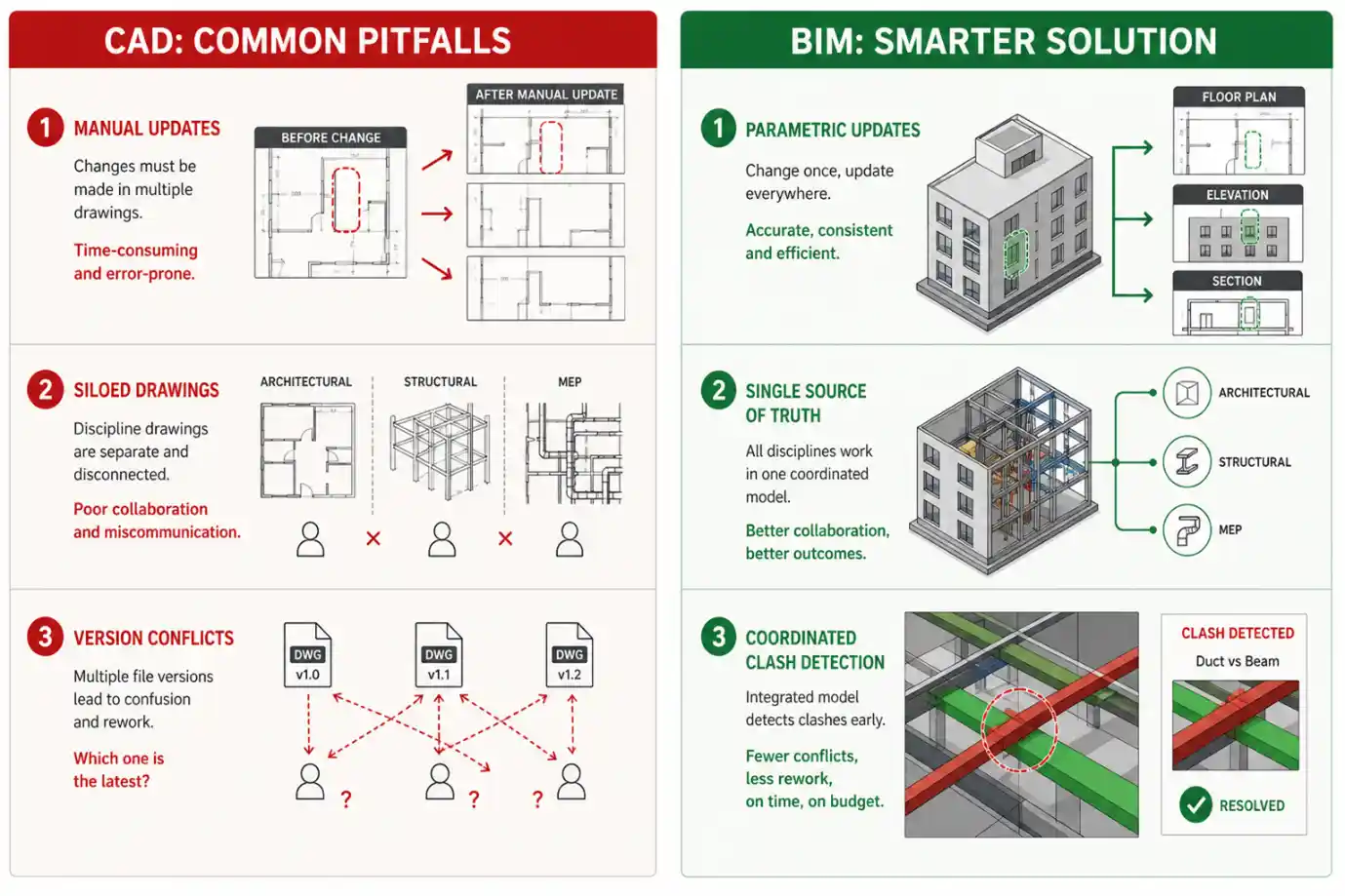
Traditional CAD vs BIM: Design Accuracy Comparison
It includes –
- Accurate dimensions and geometry.
- Coordinated architectural, engineering, and MEP systems.
- Correct material specifications.
- Reliable construction documentation.
- Consistent project data across drawings and models.
In traditional CAD-based workflows, teams often work independently on separate drawings, increasing the possibility of inconsistencies and coordination issues.
BIM solves this challenge by creating a centralized project model in which every stakeholder works with connected, continuously updated information.
This significantly reduces manual errors while improving coordination and overall project quality.
How BIM Improves Design Accuracy
1. Early Clash Detection Reduces Construction Errors
One of the biggest ways to improve design accuracy is through early clash detection and coordinated model validation.
In traditional design workflows, architectural, structural, and MEP teams often work independently, making it difficult to identify conflicts between building systems during the design stage. As a result, inaccuracies in layouts, dimensions, clearances, and service routing may remain unnoticed until construction begins.
BIM improves design accuracy by enabling architects, engineers, and MEP consultants to digitally detect and resolve these conflicts within the model before finalizing construction documentation.
For example, BIM can identify:
- HVAC ducts may intersect with beams.
- Plumbing systems may clash with walls.
- Electrical conduits may interfere with structural elements.
By resolving these issues early, architects can create more accurate, buildable, and construction-ready designs.
Here’s Something Interesting!
Nearly 40% of coordination errors can be reduced by BIM-based clash detection, improving overall construction efficiency.
2. Parametric Modeling Reduces Documentation Inconsistencies
In traditional CAD workflows, modifying one drawing often requires manually updating multiple related drawings and schedules. This increases the possibility of inconsistencies across project documentation.
BIM improves design accuracy through parametric modeling, in which all building elements remain intelligently interconnected.
If an architect modifies walls, levels, grids, or building systems, associated drawings, schedules, and quantities automatically update across the model.
This helps architects maintain:
- Consistent documentation.
- Accurate dimensions.
- Reliable schedules.
- Coordinated sections and elevations.
- Updated quantity information.
By reducing manual drafting errors, parametric BIM workflows improve the overall reliability and precision of construction documentation.
3. Level of Development (LOD) Standards Improve BIM Model Reliability
One of the most important BIM concepts that supports design accuracy is Level of Development (LOD).
LOD refers to the level of detail and reliability of a BIM model element across different project stages. It helps architects, engineers, contractors, and clients understand how accurate and dependable the model information is for decision-making and construction.
Different LOD stages represent different levels of model maturity:
- LOD 100 – Conceptual design and massing.
- LOD 200 – Approximate geometry and preliminary systems.
- LOD 300 – Accurate dimensions and coordinated elements.
- LOD 350 – Detailed interdisciplinary coordination.
- LOD 400 – Fabrication and construction-level detailing.
LOD 500 – Verified as-built conditions for facility management.
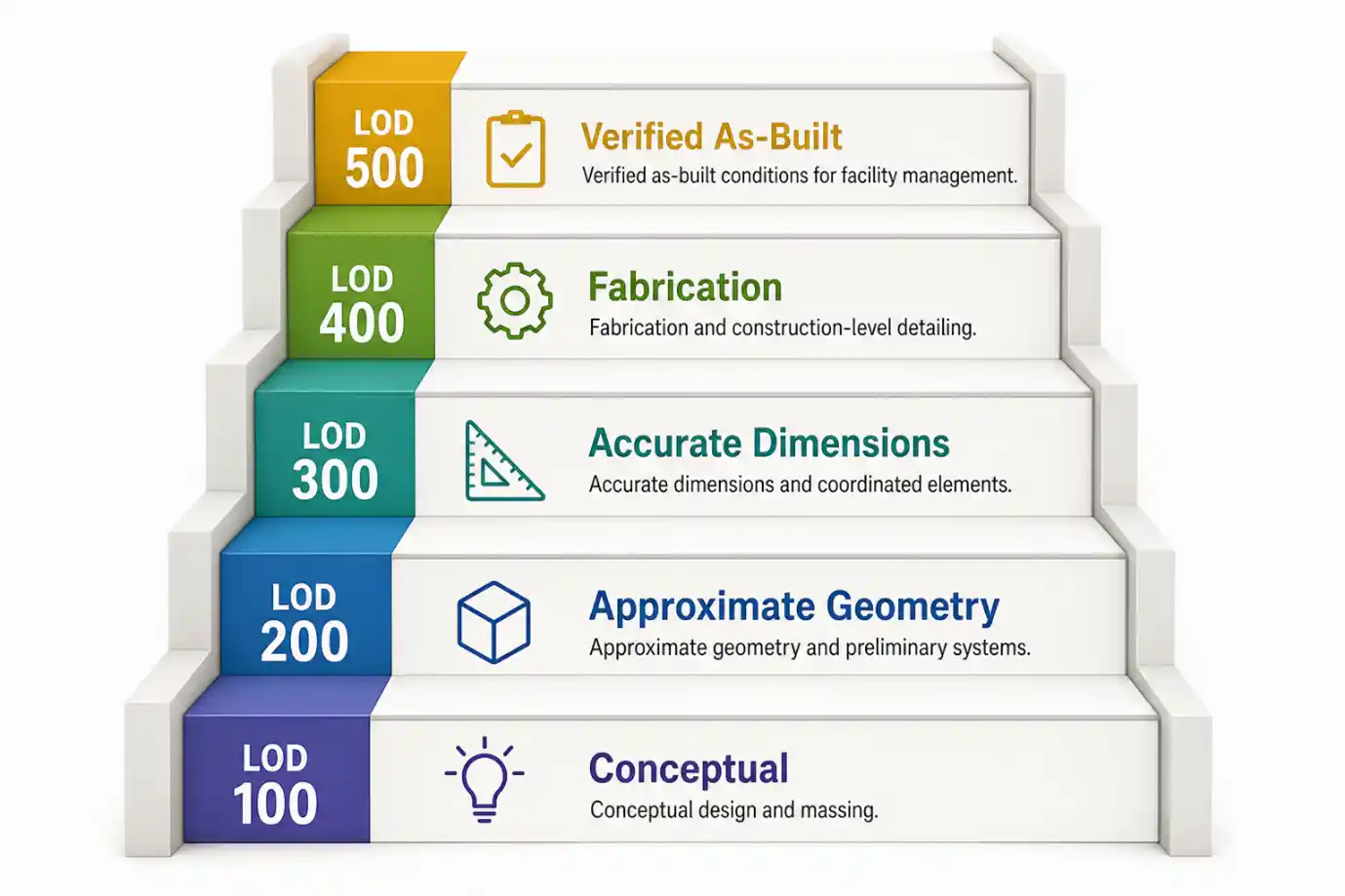
LOD Maturity Ladder
Using clearly defined LOD standards helps architects:
- Improve coordination accuracy.
- Reduce documentation ambiguity.
- Minimize construction conflicts.
- Improve stakeholder confidence.
- Enhance project planning.
In modern BIM workflows, defining the correct LOD at each project stage ensures that teams work with reliable, coordinated information, significantly improving overall design accuracy.
4. Prefabrication Workflows Improve Dimensional Accuracy
Modern construction increasingly relies on prefabrication and modular systems, where precision is critical.
Even minor dimensional inaccuracies can lead to fabrication errors, installation delays, or material wastage during manufacturing.
BIM improves design accuracy by enabling highly detailed and coordinated digital models that support fabrication-level detailing.
Through BIM-based prefabrication workflows, architects can:
- Improve dimensional precision.
- Reduce fabrication errors.
- Coordinate installation requirements.
- Improve manufacturing accuracy.
- Minimize site adjustments.
LOD 400 BIM models are especially valuable because they provide fabrication-ready information for contractors and manufacturers.
This higher level of accuracy improves both off-site manufacturing efficiency and on-site installation quality.
5. Accurate Quantity Take-offs Reduce Material Waste
Manual quantity calculations often lead to estimation errors, material mismatches, and procurement issues.
BIM improves design accuracy by generating quantities directly from the coordinated building model. Since quantity data remains linked to the model, any design change automatically updates material quantities and schedules.
This helps architects and contractors improve:
- Material estimation accuracy.
- Cost planning.
- Procurement coordination.
- Resource management.
- Waste reduction.
More accurate quantity take-offs reduce inconsistencies between drawings and construction execution, improving overall project reliability.
Research Shows That
Through better planning and coordination, BIM-supported workflows can reduce construction waste by more than 15%.
6. 4D BIM Planning Reduces Construction Coordination Issues
Construction projects involve multiple trades working simultaneously within limited site conditions. Poor sequencing often leads to workflow conflicts and execution delays.
BIM improves design accuracy by enabling 4D construction simulations, in which project schedules are directly linked to the building model.
This allows project teams to visualize:
- Construction sequencing.
- Installation order.
- Material movement.
- Site logistics.
- Equipment access.
- Temporary work planning.
By identifying workflow conflicts before execution, BIM helps architects and contractors improve the accuracy of construction planning and reduce site-level coordination issues.
Emerging Technologies Enhancing BIM Accuracy in 2026
As BIM continues to evolve, emerging technologies are further improving design accuracy by helping architects create more coordinated, data-driven, and construction-ready building models.
These technologies not only improve visualization and coordination but also help architects identify design issues earlier, reduce documentation inaccuracies, and make more informed project decisions throughout the design and construction process.
AI-Powered Clash Detection
Artificial Intelligence (AI)* is transforming BIM coordination by automating clash detection and model validation processes.
AI-powered BIM systems can quickly identify consistencies, spatial conflicts, missing information, and coordination gaps across architectural, structural, and MEP models. This helps architects improve design accuracy by detecting errors much earlier than traditional manual coordination methods.
As a result, architects can create more reliable and buildable designs while reducing RFIs, change orders, and construction rework.
Digital Twins
Digital twins connect BIM models with real-time operational and performance data from physical buildings.
For architects, this improves design accuracy by providing insights into how spaces, systems, and building components perform in real-world conditions. These insights help architects optimize future designs based on actual building behavior, improving functionality, efficiency, and long-term performance.
Digital twins also support more accurate facility planning, maintenance strategies, and lifecycle management.
Reality Capture and Point Cloud Integration
Technologies such as LiDAR scanning, drone surveys, and point cloud integration significantly improve the accuracy of existing site documentation.
Architects can use reality capture technologies to develop highly precise BIM models based on real-world site conditions rather than outdated drawings or manual measurements.
This is especially valuable for renovation, retrofit, and heritage projects where accurate as-built information is critical for reducing construction errors and coordination conflicts.
Cloud-Based BIM Collaboration
Cloud collaboration platforms enable architects, engineers, contractors, and consultants to work on shared project models in real time.
This improves design accuracy by ensuring that all stakeholders work with up-to-date, coordinated project information throughout the project lifecycle.
Real-time collaboration reduces communication gaps, minimizes version control issues, and helps teams resolve coordination problems earlier in the design stage.
As BIM technologies continue to advance, architects will be able to deliver increasingly accurate, efficient, and construction-ready projects with improved coordination and reduced project risks.
Challenges Architects Face While Implementing BIM
Although BIM offers major advantages, its implementation also comes with certain challenges:
- Initial software investment.
- Staff training requirements.
- Workflow transition from CAD.
- Managing large project datasets.
- Interoperability between software platforms.

However, the long-term benefits of improved design accuracy, reduced rework, and better project coordination often outweigh these initial challenges.
As BIM adoption continues to grow globally, firms that invest in BIM workflows gain a significant competitive advantage.
Conclusion
Design accuracy plays a vital role in every successful construction project. From improving coordination and reducing rework to supporting sustainability and minimizing project risks, BIM has fundamentally transformed the way architects design and deliver buildings.
By integrating intelligent modeling, clash detection, LOD standards, parametric workflows, and cloud collaboration, architects can achieve greater precision throughout the entire project lifecycle.
As the AEC industry continues embracing digital transformation, BIM is becoming an essential foundation for delivering accurate, efficient, and future-ready architecture.
Firms that adopt BIM strategically today are better positioned to improve project quality, reduce costly errors, and remain competitive in the evolving construction industry.
FAQ’s
BIM improves design accuracy by creating a coordinated digital model where architectural, structural, and MEP systems are integrated. This helps identify errors early and reduces inconsistencies in project documentation.
Clash detection helps identify conflicts between building systems before construction begins. Resolving these issues during the design phase reduces rework, delays, and costly on-site modifications.
Level of Development (LOD) defines the reliability and detail of a BIM model at different project stages. Clear LOD standards help teams make informed decisions and improve coordination throughout the project lifecycle.
Yes, BIM provides highly accurate and coordinated models that support fabrication-level detailing, helping manufacturers and contractors reduce errors, improve installation accuracy, and accelerate project delivery.
Want flawless, coordination-ready architectural BIM models? Partner with our BIM experts for accurate, efficient project delivery.
Contact Us